Today, many companies are exploring artificial intelligence use cases to improve daily work. These artificial intelligence use cases are no longer limited to large enterprises. Small and mid-sized businesses now use AI to save time, reduce errors, and make better decisions. Artificial intelligence is changing how businesses manage customers, sales, support, finance, marketing, and internal operations. It helps teams work faster without adding extra pressure. It also supports smarter planning by using data in a more useful way. Modern businesses do not need complex systems to start using AI. They can begin with simple tools that automate tasks and improve workflows. From chatbots to sales forecasting, AI can make business processes smoother and more reliable.
In this blog, we will discuss practical artificial intelligence use cases, common AI business applications, and useful AI automation examples. We will also look at AI in business operations and share some real world AI use cases for better understanding.
What Are Artificial Intelligence Use Cases?
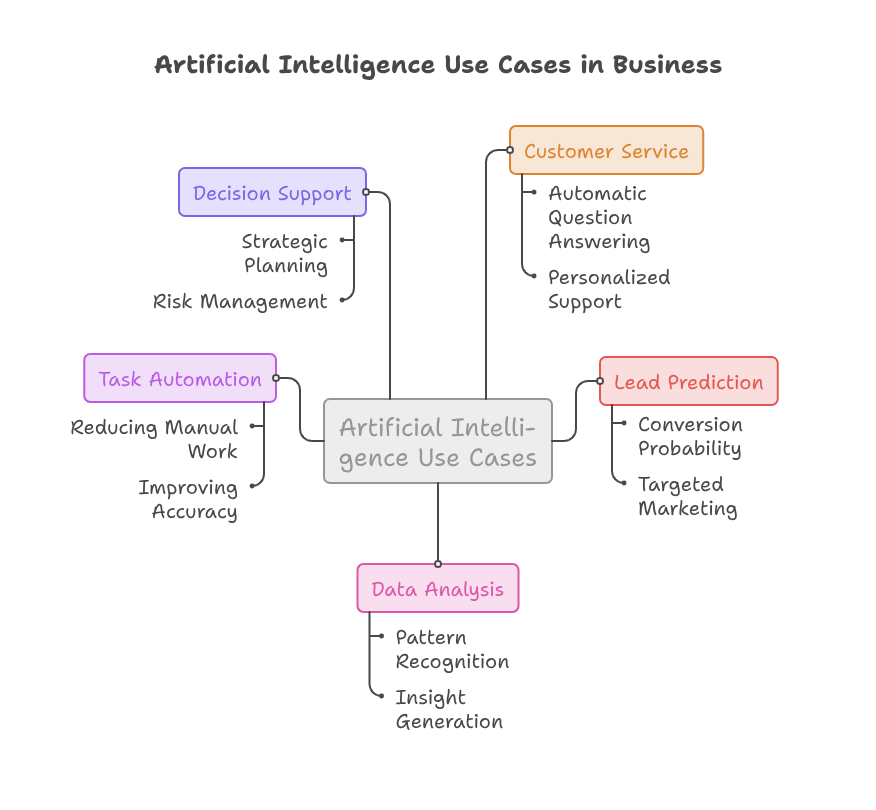
Artificial intelligence use cases are practical ways businesses use AI to solve real problems. These problems can be related to time, cost, customer service, data, or productivity. For example, a company may use AI to answer customer questions automatically. Another business may use AI to predict which leads are more likely to convert. These are simple but powerful AI business applications. AI works by analyzing data and finding patterns. It can then suggest actions, automate tasks, or support decision-making. This makes it useful for many departments. Businesses use AI to reduce manual work and improve accuracy. It can also help employees focus on more important tasks. This is why AI in business operations is becoming more common.
Why Businesses Are Using AI Today
Businesses face many daily challenges. Teams handle customer requests, sales follow-ups, data entry, reports, and internal approvals. These tasks take time and can slow down growth. AI helps by making these tasks faster and more organized. It can process information quickly and deliver useful insights. This helps business owners make better decisions. Another reason is customer expectation. Customers want quick answers and smooth experiences. AI tools can help businesses respond faster and offer better support. Many real world AI use cases show that companies can improve service quality with AI. They can also reduce operational costs and improve team performance.
Common Artificial Intelligence Use Cases in Business
There are many artificial intelligence use cases that businesses can apply today. Some are simple, while others need advanced planning. The best use case depends on business goals.
AI for Customer Support
Customer support is one of the most popular AI business applications. Businesses use AI chatbots to answer common questions. These bots can help customers even outside office hours. For example, a chatbot can answer questions about pricing, services, order status, or support tickets. It can also guide users to the right department. This improves response time and reduces pressure on support teams. It also helps customers get answers without waiting for an agent. These are strong AI automation examples for companies with frequent customer requests.
AI for Sales and Lead Management
Sales teams can use AI to manage leads more effectively. AI can score leads based on interest, activity, and behavior. This helps sales teams focus on the best opportunities. For example, AI can identify leads that opened emails, visited pricing pages, or submitted forms. It can then suggest which leads need follow-up first. This makes sales work more focused and less random. It also increases the chance of closing deals. These real world AI use cases are useful for businesses using CRM systems.
AI for Marketing Campaigns
Marketing teams can use AI to create better campaigns. AI can analyze customer behavior and suggest useful content ideas. It can also help personalize email campaigns. For example, AI can send different messages to different customer groups. A new lead may receive an introduction email. An existing client may receive an upgrade offer. This makes marketing more relevant and effective. It also helps businesses avoid sending the same message to everyone. These AI business applications can improve engagement and conversion rates.
AI for Data Entry and Document Processing
Manual data entry takes time and often creates mistakes. AI can read documents and extract useful information. This is helpful for invoices, forms, contracts, and reports. For example, AI can scan an invoice and capture vendor name, date, amount, and tax details. The system can then move this data into accounting software. This saves time and improves accuracy. It also reduces repetitive work for admin teams. These are practical AI automation examples for finance, HR, and operations teams.
AI in Business Operations
AI in business operations helps companies improve internal workflows. It can support approvals, task management, reporting, and resource planning. For example, AI can detect delays in a project workflow. It can notify managers before the delay becomes serious. This helps teams take action early. AI can also help businesses understand performance trends. It can show which departments need attention. It can also highlight processes that waste time. When used correctly, AI in business operations improves speed, visibility, and control. It also helps leaders manage work with better data.
AI for Inventory and Demand Planning
Businesses that sell products can use AI for inventory planning. AI can study sales history and customer demand. It can then suggest when to restock products. This helps companies avoid overstocking and stock shortages. It also improves cash flow and customer satisfaction. These real world AI use cases are common in retail, eCommerce, and distribution businesses.
AI for HR and Employee Management
HR teams can use AI to screen resumes and manage employee data. AI can shortlist candidates based on skills and experience. It can also help answer employee questions. For example, an AI assistant can answer questions about leave policy or onboarding steps. This saves HR teams a lot of time. These AI automation examples are helpful for growing companies with busy HR departments.
Example of a Real AI Use Case
Let’s consider a service-based business that receives many customer inquiries every day. The team gets emails, website forms, and support requests from different channels. Before using AI, the team manually reads every message. They assign tickets, reply to customers, and update records by hand. This process is slow and creates delays. Now, the business adds an AI-powered support system. The system reads incoming messages and understands the request type. It then assigns the ticket to the right department. Simple questions receive automatic replies. Complex issues go to a human agent. The system also updates the CRM with customer details. This is one of the most useful artificial intelligence use cases for service businesses. It improves response time and reduces manual effort. It also shows how AI in business operations can improve daily workflows. The business can support more customers without hiring a large team.
More AI Automation Examples for Businesses
There are many AI automation examples that can support different business needs. Some help with communication. Others improve reporting, finance, or customer management. A business can use AI to send follow-up emails after a sales call. It can also summarize meeting notes and create tasks. This saves time for sales and management teams. AI can also help finance teams detect unusual transactions. It can highlight possible errors before they create bigger problems. Marketing teams can use AI to recommend blog topics and email subject lines. Support teams can use AI to group tickets by urgency. These AI business applications are useful because they improve speed and consistency.
Benefits of Artificial Intelligence for Modern Businesses
AI gives businesses many practical benefits. It helps teams save time and reduce repetitive work. It also improves accuracy in daily processes. Another benefit is better decision-making. AI can study large amounts of data quickly. It can then provide insights that are hard to find manually. AI also improves customer experience. Customers can get faster replies and more personalized support. This builds trust and improves customer retention. Many real world AI use cases prove that AI is not only for big companies. Small businesses can also benefit from it. The key is choosing the right tools and workflows. Businesses should start with simple use cases first. Then they can expand AI step by step.
How to Choose the Right AI Business Applications
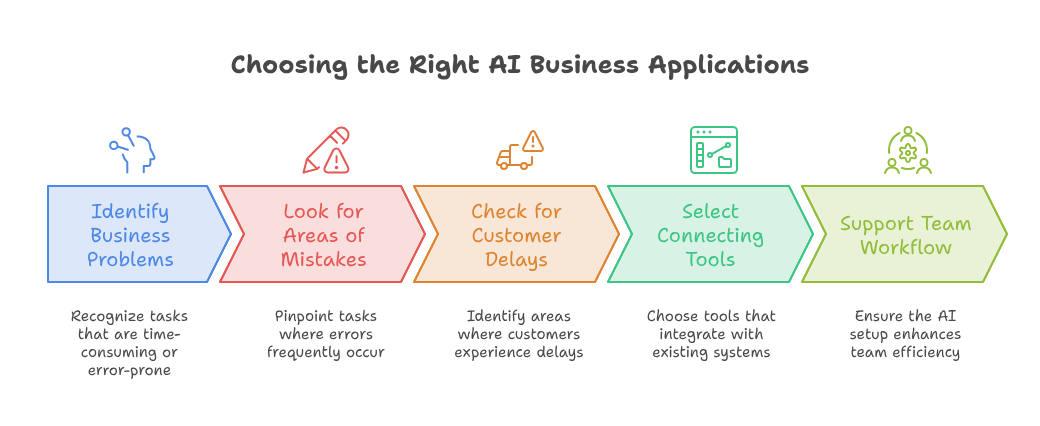
Choosing the right AI business applications starts with understanding your business problems. You should first identify tasks that take too much time. Next, look for areas where mistakes happen often. These tasks may be good candidates for AI automation. You should also check where customers face delays. After that, select tools that connect with your current systems. This is important for smooth implementation. Businesses using Zoho can connect AI with CRM, Desk, Books, Campaigns, and other apps. This makes automation more useful across departments. The right AI setup should support your team. It should not make your workflow more complicated.
Challenges Businesses Should Consider
AI can be very useful, but it needs proper planning. Poor setup can create confusion and inaccurate results. This is why businesses should not rush implementation. Data quality is also important. AI needs clean and correct data to work well. If your data is messy, the results may not be helpful. Team training is another key point. Employees should understand how to use AI tools. They should also know when human review is needed. Security and privacy must also be considered. Businesses should protect customer data and follow proper access controls. With the right strategy, these challenges can be managed easily.
Conclusion
Artificial intelligence is now a practical tool for modern businesses. It helps improve support, sales, marketing, finance, HR, and daily operations. The best artificial intelligence use cases are those that solve real business problems. Businesses should focus on areas that need speed, accuracy, and better control. From chatbots to lead scoring, AI can create clear value. These AI automation examples show how companies can reduce manual work and improve results. Zoho also plays an important role in business growth. It gives companies powerful tools for CRM, support, finance, marketing, and operations. When combined with the right AI strategy, Zoho can make business workflows stronger and more efficient.
With iTecZone as a certified Zoho partner and a team of experienced developers, you can access top-tier services for all Zoho applications. iTecZone can help you implement, customize, and optimize Zoho based on your business needs. This is why iTecZone is the perfect choice as your Zoho Consultant Partner.
FAQ’s
What are artificial intelligence use cases in business?
Artificial intelligence use cases are practical ways businesses use AI to solve problems. These include customer support, sales automation, reporting, marketing, and data processing.
What are the best AI business applications for small businesses?
The best AI business applications for small businesses include chatbots, CRM automation, email automation, lead scoring, and invoice processing.
How can AI help in business operations?
AI in business operations helps automate tasks, improve reporting, reduce errors, and support better decisions. It also helps teams manage work faster.
What are some common AI automation examples?
Common AI automation examples include automatic email replies, ticket routing, invoice scanning, sales follow-ups, and customer data updates.
Are real world AI use cases useful for small companies?
Yes, real world AI use cases are very useful for small companies. They help reduce manual work and improve customer service without large teams.
Can Zoho support AI-based business workflows?
Yes, Zoho can support AI-based workflows across sales, support, finance, marketing, and operations. With expert setup, it can improve business efficiency.
Why should I work with a Zoho partner for AI and automation?
A Zoho partner can understand your needs and set up the right workflows. This helps avoid mistakes and improves long-term results.