CRM implementation consulting services help businesses build a CRM around their real sales processes. In addition, CRM implementation consulting services improve data accuracy, automation, reporting, user adoption, and customer communication. A CRM platform may offer excellent tools, but software alone cannot solve every business problem. Therefore, companies need clear planning, proper configuration, clean data, useful integrations, and practical employee training.
This guide explains how professional CRM support can improve implementation results. It also shows how businesses can prepare for sustainable growth in 2026.
What Are CRM Implementation Consulting Services?
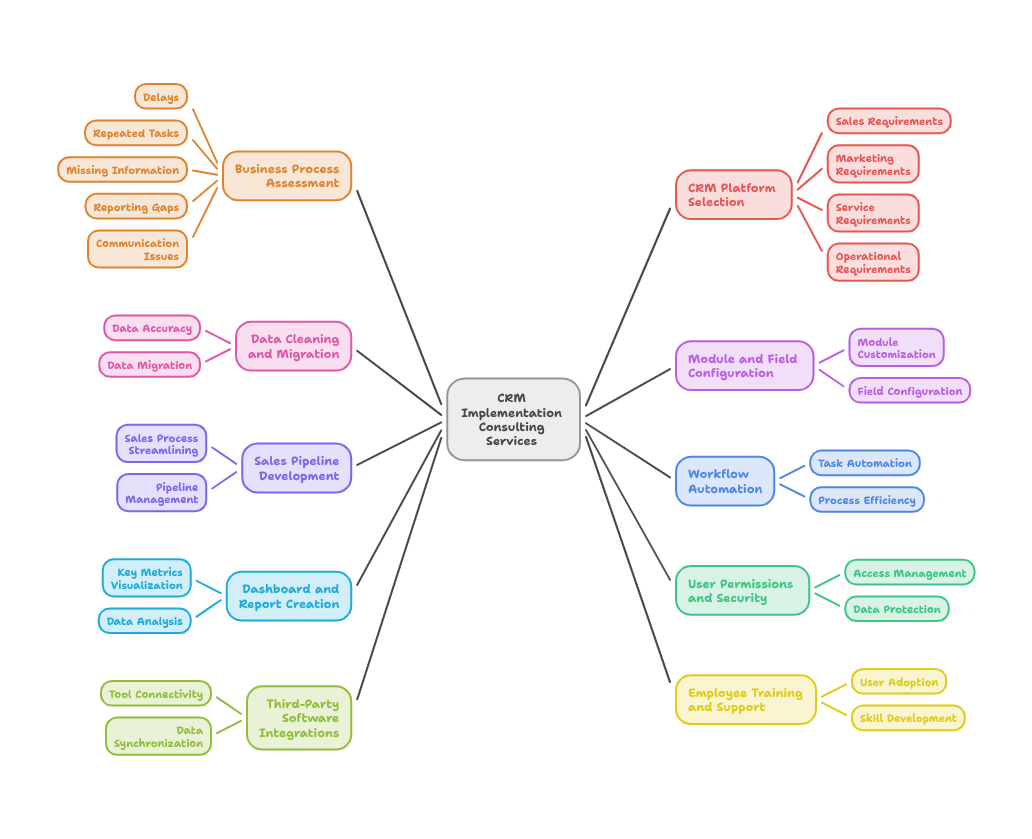
These services cover the planning, setup, customization, migration, integration, testing, and improvement of a CRM platform.
First, a consultant reviews your existing business process. They identify delays, repeated tasks, missing information, reporting gaps, and communication issues.
Next, the consultant designs a system that matches your sales, marketing, service, and operational requirements.
CRM implementation consulting may include the following areas:
- Business process assessment
- CRM platform selection
- Data cleaning and migration
- Module and field configuration
- Sales pipeline development
- Workflow automation
- Dashboard and report creation
- User permissions and security
- Third-party software integrations
- Employee training and support
Overall, the main goal is not simply launching new software. Instead, the goal is creating a reliable system that employees can use daily.
Why CRM Consulting Services Matter in 2026
Modern businesses collect customer information from websites, emails, advertisements, calls, social platforms, and support channels.
However, this information often becomes scattered across spreadsheets, inboxes, and separate applications. As a result, employees may miss follow-ups, enter duplicate records, or use outdated customer details.
CRM consulting services help companies create one reliable source of customer information. Moreover, they connect departments and provide management with clearer business visibility.
Better Planning Before Development
Many CRM projects begin without clear objectives. For example, companies add fields, modules, automations, and reports without understanding their complete process.
CRM strategy consulting helps prevent this problem. It defines business goals, user responsibilities, sales stages, approval requirements, and reporting expectations.
Furthermore, a clear strategy controls the project scope. Consequently, it reduces unnecessary customization, development costs, and future maintenance problems.
Stronger Employee Adoption
Employees often avoid systems that feel complicated or unrelated to their daily work.
Therefore, a consultant should simplify layouts and remove unnecessary fields. In addition, role-based screens should show only relevant information.
Proper training also explains how the CRM saves time and supports better customer service.
When employees understand the benefits, they enter more accurate information. As a result, they follow the correct process more consistently.
Important Stages of CRM Implementation
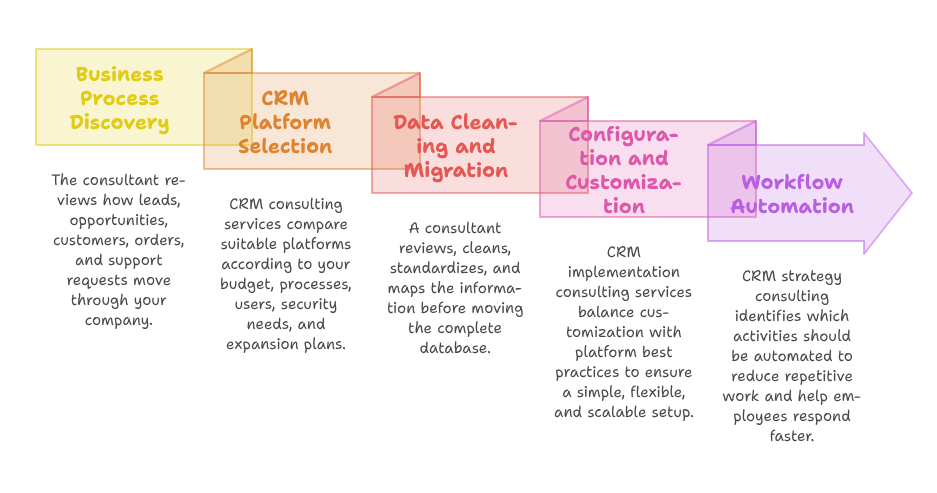
A successful CRM project requires a structured approach. Otherwise, skipping important stages can create technical problems and reduce user confidence.
Business Process Discovery
First, the consultant reviews how leads, opportunities, customers, orders, and support requests move through your company.
They also speak with managers, sales representatives, marketers, and service employees. These discussions often reveal practical problems that reports may not show.
CRM strategy consulting begins with understanding responsibilities, handoffs, approvals, delays, and performance targets.
Afterward, this information becomes the foundation for the complete CRM setup.
CRM Platform Selection
Every CRM platform offers different features, pricing, integrations, and customization options.
Some companies only need lead management and basic sales reporting. By contrast, others require marketing automation, support, inventory, accounting, or custom applications.
CRM consulting services compare suitable platforms according to your budget, processes, users, security needs, and expansion plans.
Ultimately, the selected platform should solve current problems without limiting future growth.
Data Cleaning and Migration
Data migration is one of the most sensitive stages of any CRM project.
Old databases may contain duplicates, missing fields, outdated contacts, and inconsistent formats. Therefore, moving poor-quality data can repeat existing problems.
Before migration, a consultant reviews, cleans, standardizes, and maps the information. In addition, sample migrations are tested before moving the complete database.
This process protects important customer history. More importantly, it improves trust in the new system.
Configuration and Customization
Configuration includes modules, fields, layouts, pipelines, permissions, dashboards, and notification rules.
Meanwhile, customization may include scripts, custom functions, approval systems, widgets, and purpose-built applications.
CRM implementation consulting services should balance customization with platform best practices. Otherwise, excessive customization can increase costs and make future upgrades difficult.
For this reason, a strong setup should remain simple, flexible, scalable, and easy to maintain.
Workflow Automation
Automation can reduce repetitive work and help employees respond faster.
For instance, a CRM can assign leads, schedule tasks, send notifications, update records, and request approvals automatically.
CRM strategy consulting identifies which activities should be automated. At the same time, consultants examine possible errors, exceptions, and approval conditions.
Useful automation removes delays. However, it should never make the process confusing for employees.
Why CRM Integration Services Are Essential
Most businesses use several applications for daily operations. These may include accounting, ecommerce, marketing, support, telephony, and project management platforms.
CRM integration services connect these systems with your central CRM database.
For example, website leads can enter the CRM automatically. Similarly, invoice details can move between accounting software and customer records.
CRM integration services can also connect support tickets, marketing activity, calls, payments, and order information.
As a result, connected systems reduce repeated data entry and provide a more complete customer view. They also improve reporting across different business departments.
Without proper integration, employees may need to update the same information several times. Consequently, errors become more common and productivity decreases.
Practical CRM Implementation Use Case
Consider a growing maintenance company with fifteen sales and service employees.
The company receives leads through website forms, calls, social media, and referrals. However, employees record these leads in spreadsheets and personal email accounts.
Because the process is disconnected, sales representatives regularly miss follow-ups. Meanwhile, managers cannot view accurate pipeline data or compare team performance.
The company then hires a provider offering CRM implementation consulting services.
First, the consultant maps the complete process from initial inquiry to completed service. Next, separate pipelines are created for sales opportunities and service requests.
Automatic assignment rules distribute leads according to location and employee workload.
In addition, CRM integration services connect the website, email platform, accounting software, and support system.
Automated reminders help employees complete follow-ups on time. Furthermore, management dashboards display lead sources, conversion rates, open deals, and service performance.
After training, the team begins using one shared system. As a result, response times improve and missed opportunities decrease.
Reports also become more reliable. Therefore, managers can make decisions using accurate and current information.
This example shows how structured CRM implementation can transform disconnected activities into a clear business process.
Salesforce CRM Consulting Services and Other CRM Options
Salesforce CRM consulting services support complex workflows, large databases, advanced reporting, and enterprise-level requirements.
Moreover, Salesforce offers a wide ecosystem of applications, developers, and integration partners.
However, Salesforce CRM consulting services may require higher budgets and specialized administrators. Implementation timelines may also increase when extensive customization is needed.
On the other hand, platforms like Zoho can provide a flexible option for small and medium businesses. Zoho combines CRM, finance, marketing, support, projects, and operational applications.
Therefore, the right choice depends on your budget, users, processes, integrations, and long-term plans.
Salesforce CRM consulting services remain valuable for organizations with advanced enterprise requirements. Nevertheless, businesses should compare ownership costs before making a final decision.
CRM consulting services can make this comparison easier. They help companies choose a platform based on business value instead of brand recognition.
How CRM Strategy Consulting Improves Results
CRM strategy consulting creates a clear connection between business goals and system design.
Without a strategy, companies may automate weak processes. As a result, the CRM can make existing problems faster instead of solving them.
A consultant studies lead management, customer communication, reporting, approvals, and employee responsibilities.
Based on these findings, the consultant creates a practical implementation roadmap. This roadmap includes priorities, timelines, integrations, training, and performance measures.
Moreover, CRM strategy consulting helps companies plan future improvements. Therefore, the CRM can grow with the business instead of becoming outdated.
Common CRM Implementation Mistakes
CRM projects often fail because companies focus only on software features.
Adding Too Many Fields
Too many fields make records difficult to complete. Consequently, employees may enter incomplete or incorrect information.
A better approach is to collect only useful data. Additional fields can be added later when a clear need appears.
Ignoring User Feedback
Managers may design processes without speaking with daily CRM users.
However, sales and service employees understand practical workflow problems. Their feedback can improve layouts, automation, and adoption.
Migrating Unclean Data
Poor data creates confusion from the first day.
Therefore, duplicates, outdated contacts, and incomplete records should be corrected before migration.
Skipping Training
Even a well-designed CRM can fail without proper training.
Employees need to understand both the system and the business process. In addition, they should know where to get support after launch.
Avoiding Post-Launch Reviews
A CRM project should not end immediately after launch.
Instead, performance should be reviewed after users gain practical experience. This makes it easier to correct small issues before they become larger problems.
How to Choose the Right CRM Partner
Choose a partner with technical knowledge and practical business experience.
The provider should understand sales processes, customer journeys, automation, reporting, data management, and employee adoption.
Before making a decision, ask about previous projects, industry experience, migration methods, security practices, testing, and post-launch support.
Reliable CRM consulting services should include clear documentation, realistic timelines, regular communication, and measurable project goals.
In addition, the consultant should explain recommendations in simple language. They should never push expensive features that provide little business value.
Most importantly, a trusted partner will focus on long-term results. They will not treat CRM implementation as a rushed software installation.
Benefits of Professional CRM Integration Services
Professional CRM integration services improve both efficiency and data quality.
For instance, integrated systems can automatically move information between sales, finance, marketing, and support teams.
This reduces manual work. Furthermore, it helps employees access updated customer information without switching between several applications.
CRM integration services also support better reporting. Since information comes from connected systems, management gains a wider business view.
Additionally, integrations can improve customer service. Employees can review orders, payments, support requests, and communication history in one place.
Therefore, CRM integration services are an important part of a complete implementation strategy.
Conclusion
CRM implementation consulting helps businesses turn CRM software into a practical system for sales, marketing, service, and management.
The right approach improves data quality, reporting, automation, communication, and employee adoption. Moreover, it reduces expensive mistakes during configuration and migration.
A well-planned CRM gives management greater control. At the same time, it helps employees provide more consistent customer experiences.
CRM strategy consulting also ensures that technology supports real business goals. Meanwhile, CRM integration services connect the applications required for daily operations.
Zoho can connect sales, marketing, finance, support, projects, and business operations within one ecosystem. However, proper implementation and customization are essential for meaningful results.
With iTecZone as a certified Zoho partner, you gain experienced consultants and developers. Our team supports setup, automation, integration, migration, and customization.
Therefore, iTecZone is the ideal Zoho Consultant Partner for businesses seeking reliable support and long-term CRM success.
FAQ’s
What is included in CRM implementation consulting services?
These services usually include planning, configuration, migration, customization, automation, testing, training, and post-launch support.
How long does a CRM implementation take?
The timeline depends on data volume, users, integrations, customization, and business complexity. Generally, smaller projects require less time.
Why is CRM strategy consulting important?
CRM strategy consulting connects the CRM setup with business goals. Therefore, it prevents unnecessary features, confusing workflows, and expensive redevelopment.
What do CRM integration services connect?
They can connect accounting, marketing, ecommerce, support, telephony, inventory, payment, and project management applications.
Are Salesforce CRM consulting services suitable for small businesses?
They can support small businesses with complex requirements. However, companies should carefully review implementation and administration costs.
Is Zoho suitable for growing businesses?
Yes, Zoho offers scalable applications for sales, marketing, finance, service, projects, analytics, and business automation.
Why should companies hire a certified Zoho partner?
A certified partner offers platform knowledge, technical experience, and implementation guidance. As a result, businesses reduce errors and improve system performance.
How do CRM consulting services improve user adoption?
Consultants simplify layouts, improve workflows, and provide practical training. Consequently, employees find the CRM easier to use.
Can CRM implementation consulting support future growth?
Yes, consultants design scalable systems and flexible processes. Therefore, the CRM can support new users, departments, and business requirements.